
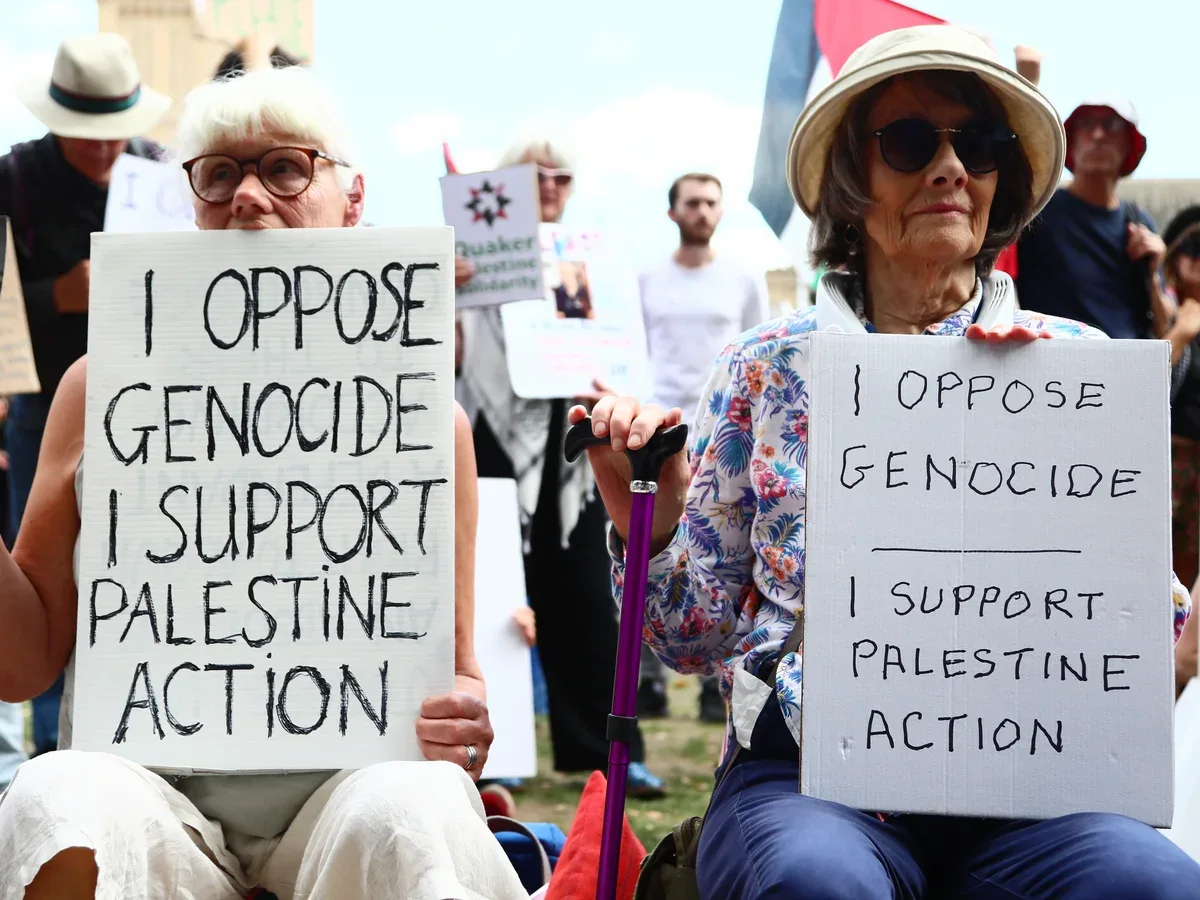
Something has gone badly wrong when ordinary people, exercising their free speech, are criminalised en masse as terrorists.
Since Palestine Action was proscribed in July 2025, around 3,000 people have been arrested in connection with supporting it. The oldest was 89. By March of this year, of the 484 charged, 456 were still awaiting prosecution when the latest official figures were compiled. Palestine Action-related cases now account for 92% of all terrorism-related arrests. One of those people, facing several charges, is my old mum.
Whatever else this is achieving, it is consuming an extraordinary amount of police, CPS and court capacity while contorting the everyday meaning of the word “terrorist”.
Palestine Action commits crimes. People who smash their way into premises and damage equipment can be arrested and prosecuted. Criminal damage, aggravated burglary and assault were crimes long before Palestine Action existed.
The question is whether proscription is also necessary.
The Government says it is. Its case is that Palestine Action's campaign crossed the statutory terrorism threshold through increasingly serious property damage, intimidation and violence.
There is another view: prosecute the crimes, but don't use terrorism law to criminalise peaceful expressions of support for the organisation responsible for them.
That distinction matters because Palestine Action is not seeking to kill civilians, or indeed to inspire terror. Its campaign seeks to disrupt companies and institutions it associates with Israel's atrocities in Palestine. It is doing so against the background of the destruction of Gaza, the displacement of Palestinians and the truly horrific scale of civilian killings. A UN Commission of Inquiry has concluded that Israel has committed genocide in Gaza and has separately documented policies aimed at forcibly transferring Palestinians and expanding Israeli control in the occupied West Bank. Israel rejects the genocide allegation.
You can disagree profoundly with Palestine Action's methods while recognising what motivates them. And you can prosecute those methods without making an 89-year-old holding a placard a terrorism suspect.
Parliament never got a clean vote
There is another problem with the proscription.
Yvette Cooper did not ask Parliament simply to proscribe Palestine Action.
The statutory instrument bundled it together with Maniacs Murder Cult and the Russian Imperial Movement, two white-supremacist organisations. MPs therefore had one choice: approve all three or reject all three.
The Commons approved the order 385–26. The Lords subsequently approved it too. But after the Commons division, Carla Denyer explicitly objected that opponents of Palestine Action's proscription had been unable to vote for proscribing the other two organisations separately.
That was a lawful parliamentary procedure. It was not a clean parliamentary decision on Palestine Action.
And that exposes a deeper constitutional problem.
Parliament is sovereign. So let Parliament decide.
Parliamentary sovereignty is not Westminster decoration. Parliament itself describes it as making Parliament the supreme legal authority in the United Kingdom.
That authority was hard won.
The struggle between Crown and Parliament ran through the Petition of Right, civil war, the deposition and execution of Charles I, the Glorious Revolution and the Bill of Rights. The settlement that emerged established the primacy of Parliament over the executive and ultimately even the rules governing who may occupy the throne.
Yet on proscription we have created an extraordinary asymmetry.
Parliament can approve an organisation being proscribed. But there is no straightforward parliamentary mechanism by which MPs and peers can initiate a decision that an existing proscription should end. The present deproscription machinery is essentially application-led, despite successive independent reviewers of terrorism legislation criticising the absence of systematic review.
That can be fixed without passing another Act of Parliament.
A few paragraphs of Standing Orders
The Terrorism Act already gives the Home Secretary power to lay an order removing an organisation from the proscribed list.
All Parliament needs is a procedure for telling the Home Secretary, with the authority of both Houses, that it believes that power should be exercised.
The proposed Standing Orders are deliberately simple.
A prescribed Early Day Motion calling for an organisation's deproscription would trigger a guaranteed Commons debate once signed by 40 MPs.
The vote would take place between 15 and 30 sitting days later. That delay is important: the Government would have time to present its case for maintaining proscription, including national-security information through appropriate channels.
If the Commons rejected deproscription, that would be the end of it.
If the Commons agreed, the resolution would automatically trigger consideration in the Lords. The process could also begin in the Lords and trigger a Commons vote.
Only if both Houses agreed would the second House present a Humble Address to the King asking that the Home Secretary lay the existing statutory deproscription order.
It doesn't legalise criminal damage. It doesn't allow 40 MPs to deproscribe anybody. It doesn't remove the Government's opportunity to defend a proscription.
It simply ensures that when enough parliamentarians believe an exceptional executive power is being wrongly used, Parliament gets to decide the question.
We may need this sooner than we think
It would be easy to see this as a procedural response to Palestine Action.
That would miss the point.
Constitutional safeguards should not be designed around whether we trust the present Home Secretary. They should be designed around the powers we are prepared to give every future Home Secretary.
The next general election must take place by 2029. Nigel Farage leads a party seeking to form the next government. Whether he ever becomes Prime Minister is for voters to determine.
But suppose he does.
We have no idea what organisations a Farage government might consider appropriate for proscription.
Nor should this question depend on Farage. Substitute any future Prime Minister whose judgment you distrust and the constitutional problem is identical.
The time to establish Parliament's ability to challenge the executive is not after a government uses its powers in a way that frightens us.
It is while those powers are being exercised by people who we hope are merely wrong, rather than nefarious.
Parliamentary primacy took centuries to establish. It is not merely Parliament's privilege; it is one of the principal protections against arbitrary executive government in the British constitution.
We are potentially one general election away from discovering how much that protection matters.
Give Parliament the mechanism now.
The attached paper outlines how, by amending Standing Orders in the Commons and the Lords, we can create a parliamentary process whereby Parliament can initiate the deproscription of a proscribed organisation.