
There are several reasons to be cautious.
Our political culture
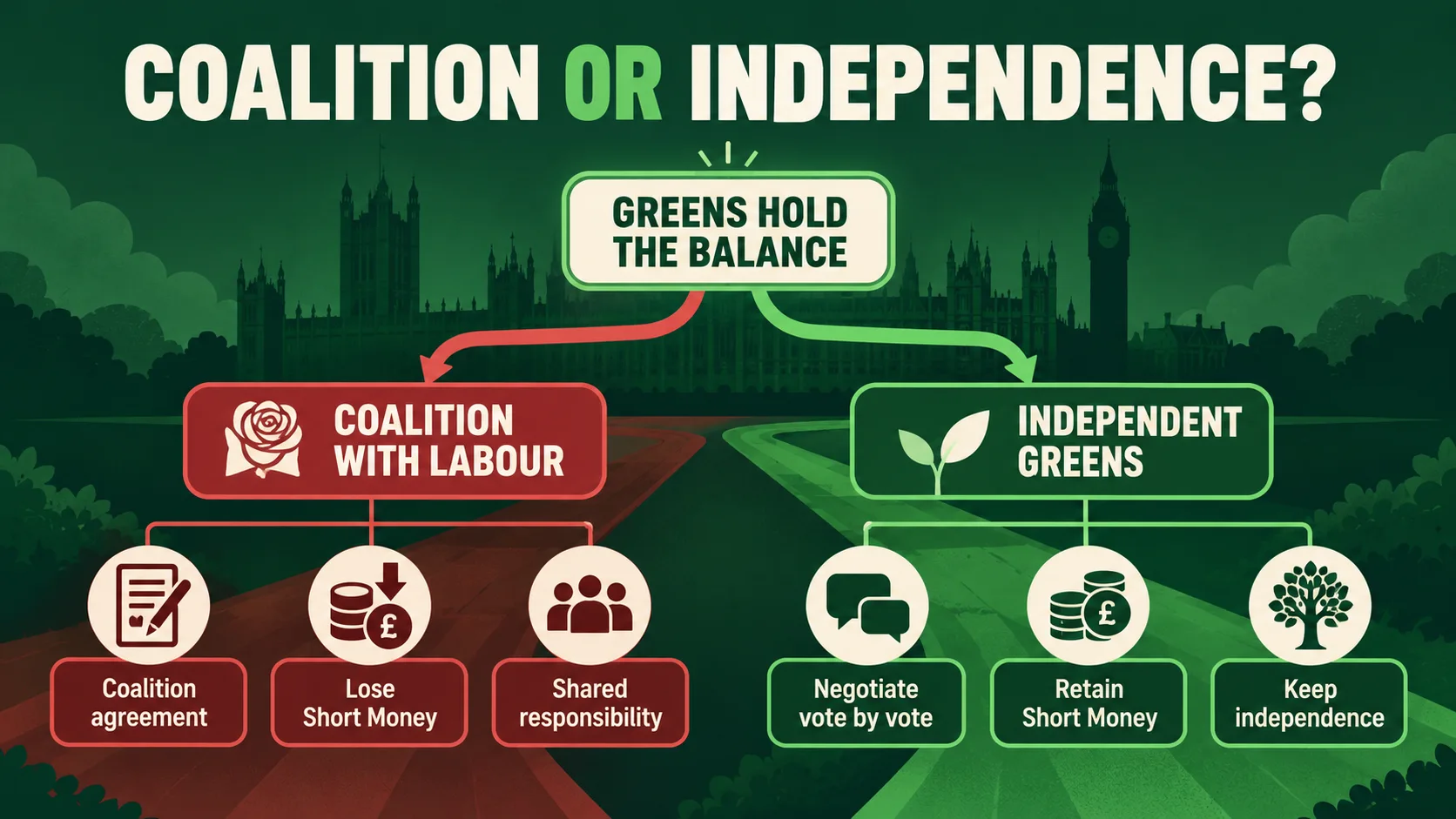
Coalitions require agreements, and agreements require parliamentary discipline. In practice, that means whips who can ensure MPs vote as promised.
The Greens don't really have that kind of political culture. Our emphasis on internal democracy and individual conscience makes it difficult to guarantee how our MPs will vote. We could change that, but would compromising our culture be worth the ministerial jobs?
The coalition trap
History suggests smaller coalition parties frequently get played by their larger partners. They share responsibility for unpopular decisions while struggling to claim credit for successes. Personally, when campaigning for renters rights as Director of Generation Rent, I recall pitching a reform to a Minister. After pondering it a bit, he said "You know, that's actually a good idea. But I need you to pitch it to the LibDem minister in my department". He explained that he could probably get the reform passed, but that if the LibDem pitched it into the department, he could win a concession from the LibDem on something else. I got the sense that the Conservatives were running rings around the LibDems on coalition politics.
The Liberal Democrats entered government in 2010 with 57 MPs. Five years later, they had eight.
Now imagine a different scenario: 50 or 100 Green MPs holding the balance of power in a hung parliament.
Instead of signing away our independence in a coalition agreement, we could negotiate with the government continuously. Every budget, every major bill, every important reform would offer another opportunity to secure concessions.
We wouldn't win every argument. But four or five years of negotiations could deliver more change than one coalition agreement negotiated over a few days.
There's also the money
One of the less discussed disasters of the Liberal Democrats' 2010 coalition was financial.
By entering government, they lost approximately £1.75 million annually in Short Money - public funding provided to opposition parties to support their parliamentary work. The loss caused severe financial difficulties and contributed to more than 20 redundancies at party headquarters.
Short Money is calculated according to the number of MPs elected and the votes received at the previous general election.
Consider three illustrative, potential Green election results, using the 2026/27 funding rates:
Green MPs | Green votes | Annual Short Money |
|---|---|---|
10 | 2 million | £708,303 |
50 | 4 million | £2,125,513 |
100 | 6 million | £3,779,026 |
These figures exclude the separate allowance for parliamentary travel and assume the Greens remain in opposition. Future rates will change with inflation.
At 100 MPs, that's over £15 million across four years, before inflation.
This isn't simply money for the party to spend however it likes. Short Money can legally fund policy researchers, specialist policy advisers, staff supporting shadow ministers, government scrutiny and communicating alternative policies. It cannot fund election campaigns, membership recruitment or fundraising.
Imagine what the Greens could achieve with properly resourced teams working on housing, climate, economic policy, public services and international affairs. The capacity to scrutinise government proposals, develop credible alternatives and turn our principles into detailed legislation would be transformative.
And because those parliamentary functions would be publicly funded, our membership subscriptions and donations could remain available for campaigning and other party activities.
Independence might be worth more than office
There is precedent for supporting a government without joining it. The DUP's confidence-and-supply arrangement with the Conservatives from 2017 to 2019 allowed it to retain Short Money while exercising considerable parliamentary influence.
Of course, if the Greens held the balance of power, we would have to act responsibly. Governments need to pass budgets and survive confidence votes. But responsibility doesn't require surrendering our independence.
Our ambition should be to change what governments do, not simply to acquire ministerial titles.
A powerful, independent Green parliamentary party might achieve more than a junior partner in government - politically, organisationally and financially.
How much could the Greens receive under different election outcomes?
Try the Greens Assemble Short Money calculator - enter different numbers of MPs and votes to see what an independent Green parliamentary party could be worth.