
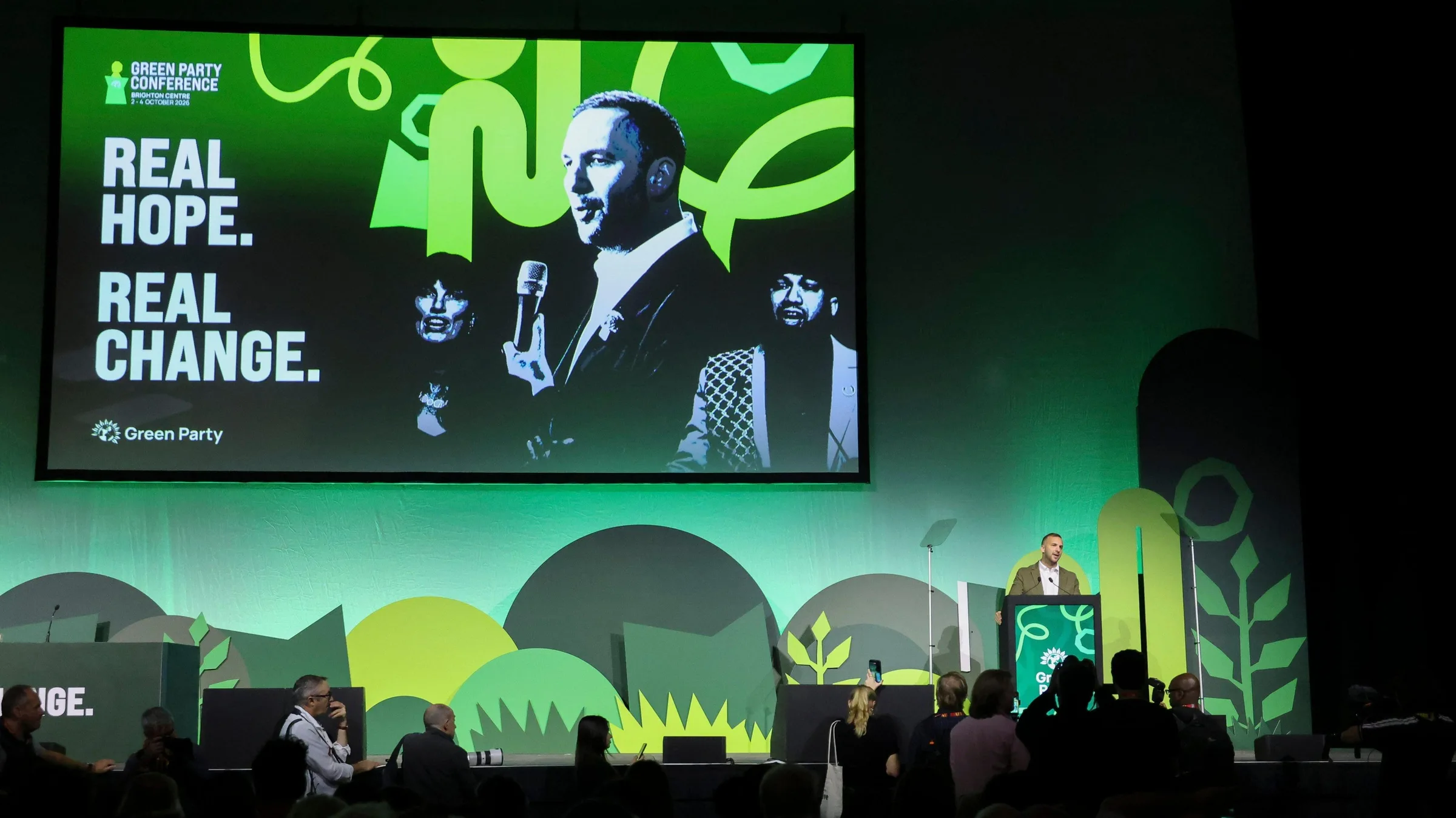
At Autumn Conference 2026, the Green Party adopted Motion E02/A105, declaring us an anti-Zionist party, defining Zionism as racism and supporting a single democratic Palestinian state throughout historic Palestine.
The motion passed by 1,022 votes to 813. It was a legitimate Conference decision, reached through the party's democratic procedures. But democratic decisions are not beyond reconsideration.
The controversy has continued to dominate coverage of the Green Party. Senior Greens have publicly criticised the decision, Jewish members have expressed distress, and European Green parties have questioned its compatibility with their own positions.
For a party seeking to become a major force in British politics, this presents both a political problem and a fundamental question of principle.
This article lays out the case for, and drafts, a replacement motion to a future. Please support the motion here.
Zionism isn't one simple idea
Modern political Zionism emerged in the nineteenth century, but the Jewish relationship with Zion, Jerusalem and the land of Israel is vastly older. Its roots reach into the ancient Near Eastern religious world from which Judaism itself emerged. Some of the oldest texts of the Bible reflect a world in which peoples, lands and gods were intimately connected, while the biblical story repeatedly returns to the relationship between the Jewish people and the land: possessing it, losing it, living in exile and hoping to return.
Longing for Zion, attachment to Jerusalem and the memory of Jewish national life in the ancient land of Israel are woven into Jewish religious practice, literature and identity for millennia. That history predates modern political Zionism by thousands of years. These traditions cannot simply be removed from Judaism without profoundly changing significant parts of its inherited religious and cultural life.
That does not mean all Jews are Zionists. They are not. Nor does it mean that Judaism and political Zionism are interchangeable.
Some Jews reject Zionism entirely. Others understand it simply as support for Jewish national self-determination or Israel's continued existence. Still others embrace political interpretations that have been used to justify the dispossession, domination and discrimination of Palestinians.
But beneath the modern political arguments, Zion is deeply embedded in Jewish religious and cultural tradition. Whatever we think of Judaism, or religion in general, we should respect the beliefs of others where those beliefs are not being used to justify harm to other people. We should also be extremely cautious about taking an ancient and multifaceted element of Jewish identity and declaring that the word associated with it has one permissible political meaning. We could just as easily pass motions declaring Christianity and Islam as synonymous with misogyny and homophobia on that basis.
These distinctions matter.
The Israeli government and political leaders have invoked Zionism and Jewish national self-determination to justify policies that deny Palestinians their rights. Where Zionism is invoked to justify racial domination, discrimination or dispossession, those arguments deserve unequivocal condemnation as racist. The government of Israel itself has hijacked the ancient concept of Zionism to justify racist atrocities, and it is understandable that some non-Jews think that that is Zionism.
But it does not follow that a Jewish person who believes Israel should continue to exist alongside an independent Palestine is necessarily racist.
The October motion risks collapsing these profoundly different positions into a single category.
Human rights cannot be rationed
The Green Party's commitment to universal human rights must mean exactly that: universal.
The rights of Palestinians to freedom, security, equality and national self-determination cannot be conditional upon Israeli approval.
Equally, the rights of Israelis to security, equality and national self-determination cannot be conditional upon Palestinian approval.
Human rights rationed to a selected group of people are not universal human rights at all.
This principle does not diminish the severity of Israel's conduct in Palestine, including genocide and ethnic cleansing.
Condemning those actions does not require denying the legitimacy of Israel's continued existence. Nor does recognising Israel's existence require accepting occupation, settlement expansion or the denial of Palestinian rights.
A two-state settlement based on the pre-1967 lines, with mutually agreed territorial exchanges and internationally guaranteed security, provides one framework for recognising the national self-determination of both peoples.
There are substantial disagreements about whether such a settlement remains achievable. Those disagreements deserve serious consideration. But support for that outcome cannot reasonably be treated, by itself, as evidence of racism.
Worse, the Israeli government's political argument has increasingly sought to portray Jews, Israelis and Zionists who oppose its actions as somehow betraying Israel or the Jewish people. By defining Zionism itself as racism, the Green Party accepts the other half of exactly the same false choice: that support for Israel's continued existence and opposition to the Israeli government's actions cannot coexist.
They can. They must.
Drawing the line where we have may make some of us feel that we are unequivocally on the right side. But it risks strengthening the very political argument we should be challenging: that Jewish identity, Zionism and support for the actions of the Israeli government are inseparable.
The political consequences
The controversy has rapidly become the central feature of media coverage of the Green Party. Right now, it is difficult to find any broadcast or newspaper coverage of the party that does not return to this controversy.
That's not just an inconvenience for our leadership. It risks permanently obscuring the party's positions on climate change, housing, public services, inequality and democratic reform - and even other human rights issues.
Critics argue that the October decision places the Greens outside the political mainstream. Supporters of the motion argue that it expresses a principled commitment to Palestinian liberation and opposition to ethnonationalism.
The disagreement is genuine. So is the damage that prolonged internal conflict can do to a party's ability to communicate its wider programme.
My concern is that the motion creates an unnecessary conflict between the party's commitment to Palestinian rights and its commitment to universal human rights.
The Greens should be able to condemn the Israeli government's conduct without appearing to condemn Jewish people whose understanding of Zionism is not racist.
Whether the party can resolve that distinction will matter well beyond this particular controversy.
Holborn and St Pancras: a result worth celebrating
The Green Party should not attribute Zack Polanski's defeat in Holborn and St Pancras to the Zionism controversy.
We don't know how many votes the controversy cost the party but it's unlikely that was the deciding factor.
The constituency was always a difficult prospect. Labour had held it for decades, and the Greens entered the contest from a distant starting position.
But Zack secured 33% of the vote, more than tripling the Green share from the 2024 general election.
It was the Green Party's second-best parliamentary by-election result in our history and our strongest result ever in Holborn and St Pancras.
That deserves recognition.
Zack, the local campaign team, the central party, members and volunteers delivered an impressive campaign. Labour won, but the Greens were the only other party seriously competing for the seat.
As the Green Party grows, we must become accustomed to fighting major electoral contests in which victory is possible but never guaranteed.
Sometimes parties win. Sometimes they lose.
The important questions are what they achieve, what they learn and how they develop.
The Holborn result demonstrated substantial progress. It should not be rewritten as a failure simply because the party did not win. There's a long list of seats where, in the current political climate, 33% is a winning figure.
But without serious examination of the political consequences of the October Conference decision, it will become a permanent anchor on our future prospects.
We're not here just to shout. We need 100 MPs to ensure that no-one can govern without Green consent, and radical change on a wide range of important policy areas in order to win that consent.
An opportunity at Conference
UPDATED:
New policies are blocked from change for 21 months after their passing. The next opportunity for members to reconsider the policy is Spring Conference 2028.
A proposed motion, Israel and Palestine: Two States and Mutual Self-Determination, would ask Conference to rescind the provisions of E02/A105 that declare the party anti-Zionist, classify Zionism as racism and endorse a single-state settlement.
It would replace those provisions with support for Israeli and Palestinian national self-determination through two states, based on the pre-1967 lines with mutually agreed territorial exchanges and permanent international security guarantees.
The motion would also ask the party to apologise to Jewish people in Britain and elsewhere who have felt attacked, ostracised, unwelcome or threatened by the breadth of the October decision.
It would retain explicit condemnation of racist invocations of Zionism, opposition to occupation and discrimination, and support for Palestinian rights.
The proposal doubles down on criticism of the Israeli government. It asks members to distinguish that criticism from the question of whether Israel should continue to exist.
The Green Party is entering a period in which its decisions may have consequences far beyond those experienced when it was a much smaller political organisation.
That makes the way it resolves disagreements about fundamental principles increasingly important.
Members should have the opportunity to examine the proposed replacement, debate its implications and decide whether it better reflects the party's commitment to universal human rights.
Read the proposed Conference motion and consider whether to add your support.
When we look back at this moment, we can see it as the moment we matured into a serious party, or the moment we killed the Green Party as a force for change. Which of these paths we take is in our hands.
Draft motion to Conference
Israel and Palestine: Two States and Mutual Self-Determination
Conference notes that:
The Israeli government's occupation, settlement expansion, displacement of Palestinians and conduct of military operations have involved grave violations of international law and fundamental human rights, including genocide and ethnic cleansing.
The Israeli government and elements of its political leadership have invoked Zionism, Jewish national self-determination and historical entitlement to justify the occupation, dispossession, segregation and systematic discrimination of Palestinians.
Such invocations of Zionism to justify racial domination, discrimination, dispossession or the denial of Palestinian rights are racist and must be unequivocally condemned. Neither national identity, historical entitlement nor national self-determination can justify the denial of those same rights to another people.
Zionism is, however, understood in different ways by different people, including by those whose understanding extends no further than support for the continued existence of the State of Israel alongside a sovereign Palestinian state. Such support does not, in itself, constitute racism.
Motion E02/A105, adopted at Autumn Conference 2026, may therefore inadvertently define as racist people whose support for Zionism consists solely of support for the continued existence of the State of Israel, including as part of a two-state solution.
Many advocates of a two-state solution reject racism, occupation and discrimination, and support two states precisely because they seek peace, security, equality and national self-determination for both Palestinians and Israelis, and the safety, freedom and prosperity of the Palestinian people.
The right of Palestinians to national self-determination and the right of Israelis to national self-determination are not mutually exclusive.
Conference therefore resolves that:
The provisions of Motion E02/A105 adopted at Autumn Conference 2026 which declare the Green Party to be an anti-Zionist party, define Zionism as racism, require Zionism to be treated as a form of racism, and commit the Party to explicitly opposing Zionism are rescinded.
The provision of Motion E02/A105 supporting the establishment of a single Palestinian state throughout historic Palestine is rescinded.
The Green Party fully and wholeheartedly, and with profound regret, apologises to Jewish people in Britain and elsewhere who, as a consequence of the wording and insufficiently considered breadth of Motion E02/A105, have felt attacked, ostracised, unwelcome or threatened. Conference recognises in particular the hurt and alarm that may have been caused to Jewish people whose understanding of Zionism is centred upon the continued existence and security of Israel, but who oppose racism, occupation, dispossession and violations of Palestinian rights.
The Green Party supports the right of both Palestinians and Israelis to national self-determination and supports a negotiated two-state settlement based on the pre-1967 lines, with mutually agreed territorial exchanges, resulting in a sovereign and viable State of Palestine alongside the State of Israel.
The Green Party supports permanent mutual security guarantees between Israel and Palestine, underpinned by guarantees from the international community and its institutions.
The Green Party supports equal civil, political and human rights for Palestinians and Israelis and opposes antisemitism, anti-Palestinian racism, Islamophobia and all other forms of racism and discrimination.
Nothing in this motion prevents criticism or condemnation of the policies or actions of the Government of Israel, advocacy for Palestinian rights, or opposition to occupation, settlement expansion, dispossession, discrimination or breaches of international law.
This motion supersedes any provision of previous Conference motions inconsistent with the above.