
When I was 12, I got beaten up by a gang on the streets of East London for being Jewish.
I'm not Jewish. I'm half Indian. But while I was on the ground, I remember very clearly thinking to myself: "I'd rather be Jewish and taking a kicking right now than be whatever the fuck you are."
Even 40 years later, I think of it as the day I was Jewish.
That's the day, I guess, that I internalised solidarity; when it became a core value to me.
It's the reason why I have solidarity with the Palestinian people as they face genocide in Gaza. It's also why I condemn the October 7 atrocity committed by Hamas.
It's why I can support Ukraine defending itself against Russian invasion while still believing that the deliberate targeting of civilians is wrong. Civilian deaths may occur in war. That doesn't make civilians legitimate targets.
You simply cannot purport to support human rights if you don't support all humans' human rights. That means the human rights of Israelis, Palestinians, Jews, Muslims and everyone else. It includes humans in Britain, humans in the Middle East and humans everywhere else. Believing that human rights can be rationed according to your opinion of a people’s worthiness is no belief in human rights at all.
Right now I'm concerned with the immediacy of the catastrophe facing the Palestinian people. But I'm also horrified by the day-to-day fear that many Jews in Britain live with. And in Britain, antisemitism and Islamophobia are tools of the far right, whose agenda depends on making minorities afraid.
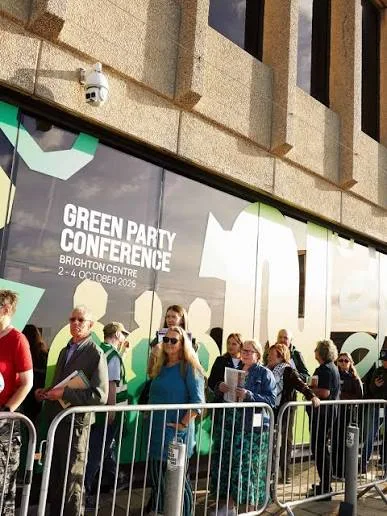
Yesterday's "Zionism is racism" vote at Green Party conference troubles me for that reason. I also think it's bad politics.
I didn't go to Green Party conference. I didn't really want to spend the money and figured I'd be more useful volunteering in the Holborn & St Pancras by-election. When I heard about the motion, I thought, "Oh bugger, that needs to be nipped in the bud", and then didn't think any more of it.
But a party of more than 200,000 members has now put itself in a political bind because 1,022 members voted for the motion and 813 voted against it. A majority of just 209 votes.
Whatever your view of the substance, that is a remarkably small number of people to make such a consequential statement on behalf of such a large party.
But we should also be precise about what we're arguing about.
There are plenty of things about the constitutional arrangements of Israel that I dislike. I don't believe states should privilege religions or ethnic groups. But Israel is hardly alone in intertwining the state with religion. More than 80 nations officially favour a particular religion. Iran is among them. So is the United Kingdom.
Israel's constitutional position goes further than simply having an established religion. Its 2018 Nation-State Basic Law declares Israel the nation-state of the Jewish people and says that the right to national self-determination within the state is unique to the Jewish people. That raises serious questions about equality in a state whose citizens are not all Jewish.
But none of this establishes that every person who believes Jews should have a national home is therefore a racist.
And that's where I think the conference motion runs into reality.
We have to recognise the work of Zionists who campaign for Palestinian human rights far more actively than most of us ever will, and who sometimes do so at considerable personal cost.
Yehuda Shaul is a former IDF soldier who co-founded Breaking the Silence. He calls himself a Zionist while arguing that Jewish self-determination cannot be achieved by denying Palestinians the same right, and that Israel's security ultimately requires a sovereign Palestinian state alongside it.
Breaking the Silence has collected testimony from Israeli soldiers about abuses under occupation and campaigns publicly against that occupation.
Rabbis for Human Rights brings together more than 170 Israeli rabbis and rabbinical students and works directly with Palestinian communities, with 1,000 volunteers providing humanitarian assistance, accompanying shepherds and farmers and maintaining a protective presence in communities threatened by settler violence.
The wider Reform Jewish movement is explicitly Zionist and has likewise condemned attacks upon Palestinians and supported sanctions against perpetrators of settler violence.
This isn't easy or risk-free.
Israeli human-rights activists have been denounced as traitors and faced sustained political attempts to delegitimise and restrict their organisations. Benjamin Netanyahu himself sought foreign governments' help in cutting funding to Breaking the Silence.
Israelis who physically stand alongside Palestinians can face the same violent settlers they're trying to restrain. In 2025 a Rabbis for Human Rights delegation helping Palestinians with the West Bank olive harvest was attacked by extremist settlers. A drone injured Rabbi Dana Sharon before armed settlers arrived, one of whom fired into the air.
Who, among us, has put themselves in the literal line of fire for the sake of Palestinian Human Rights, in the way these Zionists have done?
These people can be Zionists while vehemently opposing occupation, dispossession, settlement expansion and violence against Palestinians. Treating every form of Zionism as synonymous with racism risks erasing some of the Israelis taking significant personal and political risks in defence of Palestinian rights.
These people aren't racists.
They're defenders of human rights.
And we don't even have to travel to Israel to find the contradiction.
Vivien Lichtenstein is co-chair of Jewish Greens.
She has been involved in Israeli-Palestinian peace and Palestinian human-rights campaigning since 1982. She has worked with Jewish-Arab Dialogue and Jews for Justice for Palestinians. She has visited Palestinian projects in Hebron, the South Hebron Hills, Bethlehem, Silwan, East Jerusalem and Jenin. She has demonstrated in Palestine against Israeli settlements and the separation wall.
Jewish Greens has described "freedom for Palestinians, and an end to genocide and apartheid" as non-negotiable.
Lichtenstein does not describe herself as anti-Zionist.
And following this vote, she has said that she is considering leaving the Green Party.
We should think very carefully about that.
If our response to a Jewish woman who has spent more than forty years campaigning for Palestinian human rights is to tell her that her understanding of Jewish self-determination makes her a racist, I think we have lost sight of what anti-racism is supposed to achieve.
There is an important distinction between saying that some forms of Zionism are racist and saying that Zionism is racism.
There plainly are forms of Zionism which demand permanent Jewish supremacy, dispossession of Palestinians or unequal rights. I have no difficulty describing those ideas as racist. Islam, Judaism and Christianity have countless examples of institutional misogyny, but I wouldn’t support a motion defining Muslims, Christians and Jews as misogynist.
Zionism is a broad and contested political tradition. At its most minimal, it can mean simply believing that Jewish people possess a right to national self-determination in some part of their historic homeland. People who hold that belief disagree profoundly about borders, settlements, occupation, Palestinian statehood and whether Jewish self-determination is compatible with equal national rights for Palestinians.
Calling all of those people racist doesn't illuminate those differences. It obliterates them.
Israel exists. Whatever one believes about the legitimacy of its creation, millions of people have now been born there and know nowhere else as home.
Its creation involved terrorism, war and the mass displacement of Palestinians in the Nakba. Those facts should not be sanitised. Nor should Britain's role in its history be forgotten. But history does not make the human rights of the people living there today conditional.
Our concern should be for the human rights of humans today.
Palestinians should be able to live without fear.
Israelis should be able to live without fear.
Jews and Muslims in Britain should be able to live without fear.
And people who stomp on the human rights of others should be held accountable for their crimes, whoever they are.
The devastation of Gaza and the genocide identified by the UN Commission of Inquiry demand international action and support for Palestinian self-determination. The Israeli government rejects the genocide finding, and the International Court of Justice has not yet made a final determination in the case before it. But none of that should prevent us from confronting the extraordinary scale of Palestinian death, displacement and destruction.
I continue to believe in two states, broadly based upon the 1967 borders. Not because it is a perfect solution. There isn't one. But because Palestinian self-determination and Israeli self-determination do not have to be mutually exclusive propositions.
And peace certainly isn't made easier if we choose to vilify Israelis who are putting themselves in far more jeopardy than we are in defence of Palestinian human rights.
A political ideology can contain racist forms without every person who identifies with that political tradition thereby being a racist.
So yes: some Zionists are racists, and some members of the Israeli government are racist.
But some Zionists are defending Palestinian farmers from violent settlers. Some are documenting abuses committed by their own army. Some are fighting the occupation. Some are demanding Palestinian statehood. Some are risking their safety and their standing in their own society to defend the human rights of Palestinians.
Some Zionists are heroes.
They are our allies in our support of Palestinian statehood and security. Jewish Greens are likewise our allies. And once we turn on our allies, it makes our goals less likely to be achieved; not just our goal for justice in Palestine, but our goal to elect 100 MPs to the British Parliament at the next election.