
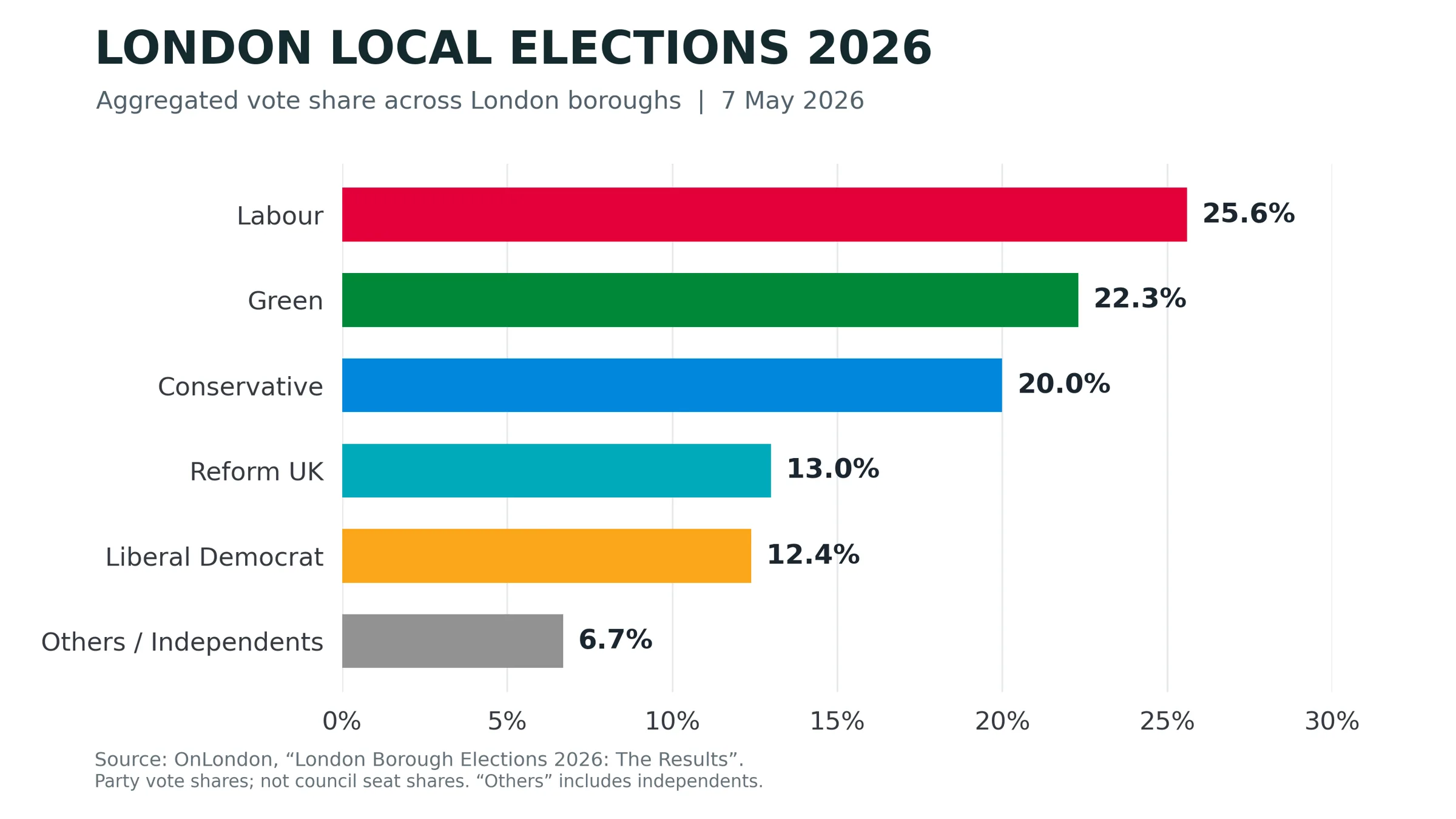
While the Burnham bounce has done the Green Party no favours in the polls, our performance in London’s 2026 local elections indicates that we have a difficult but credible path to taking the London mayoralty in 2028.
This isn’t a complete strategy paper, but I do explore here what political positioning the Green Party needs in order to navigate this narrow path.
We have to start with national polls, as they are a regular indicator of party support.
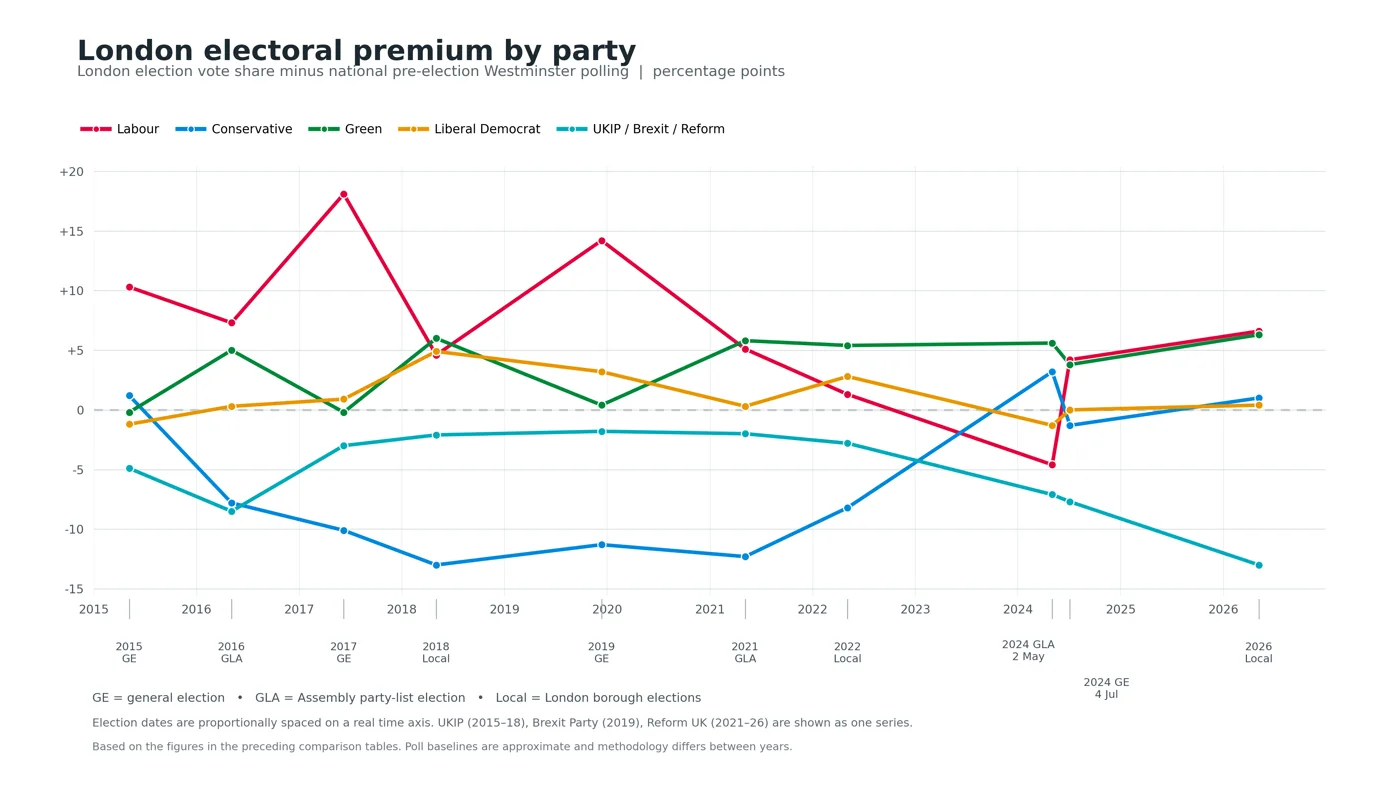
What is notable is that the Green Party consistently performs about 5-6% better in London than the national polls, except in general elections, though even that may be changing. This is important because it allows us to estimate what kind of polling we need in order to compete for the London mayoralty.
Next we have to look at the 2026 local elections in London.
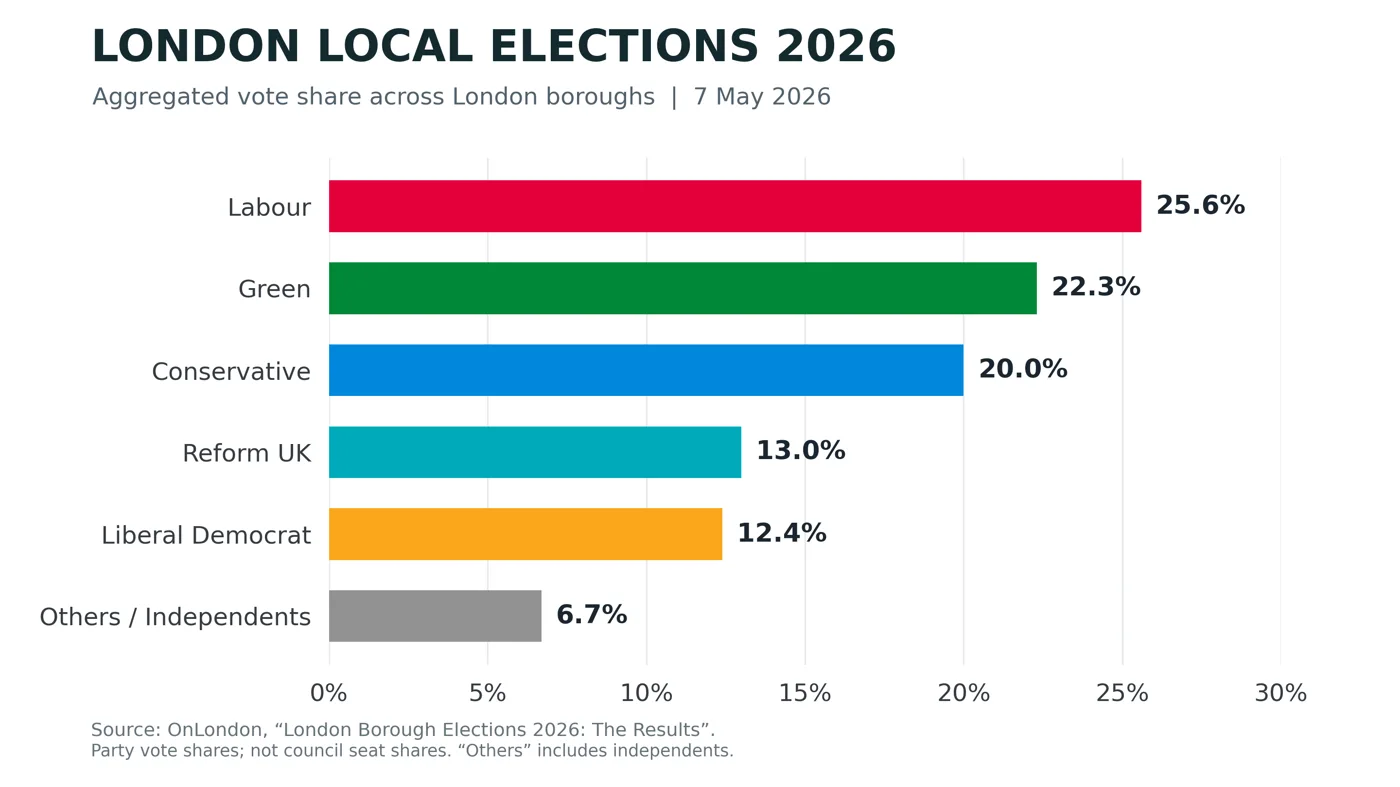
These elections were of course a groundbreaking success for the Green Party. We not only came second to Labour but it was very close indeed, with the Greens only 3.3% behind Labour. Even more remarkable is that the roughly 42% turnout in the local elections was marginally higher than the 40.5% turnout in the 2024 GLA elections, so we are able to treat them as a comparable electorate. Obviously, the local elections aren’t the Mayoral elections, but we can demonstrate that the result was in keeping with our 5-6% uplift over national polls, that we would also expect to see in a GLA election.
Because the London mayoral election is returning to the Supplementary Vote method. We also have to consider voters’ second preferences. Fortunately, three recent studies have looked into voter 2nd preferences, so we are able to make a Sankey diagram from those studies in aggregate.
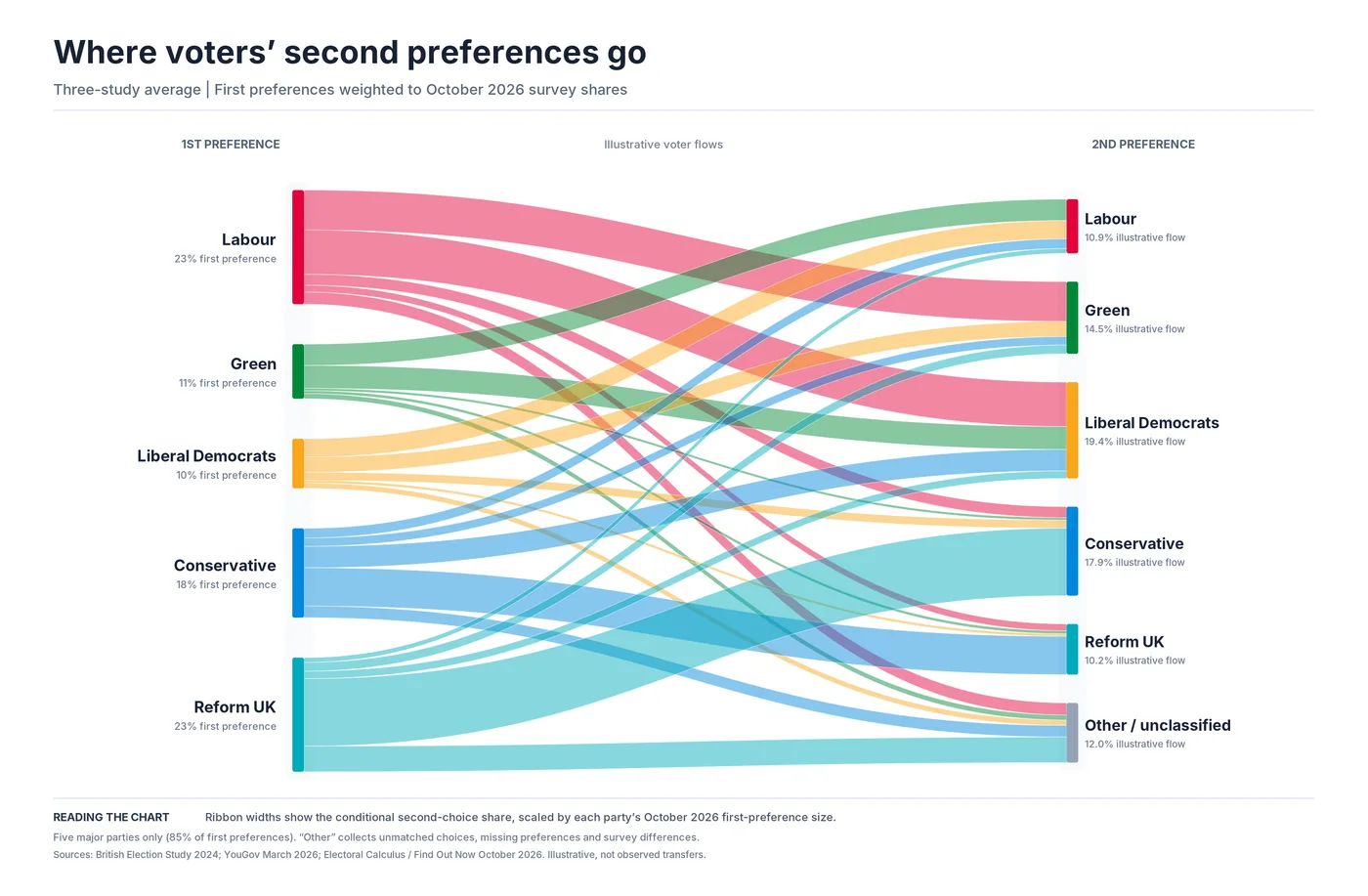
Second-preference estimates are based on an unweighted average of three studies: Miori and Green's analysis of the 2024 British Election Study, YouGov's March 2026 ranked-preference survey, and Electoral Calculus/Find Out Now's October 2026 tactical-voting survey. The studies used different methods for measuring preferences, so our combined figures are illustrative modelling assumptions, not a statistically representative polling average or a prediction of actual transfers in London.
However, they enable us to estimate what would the 2026 London local election results be if Labour and the Greens were in a top-two runoff.
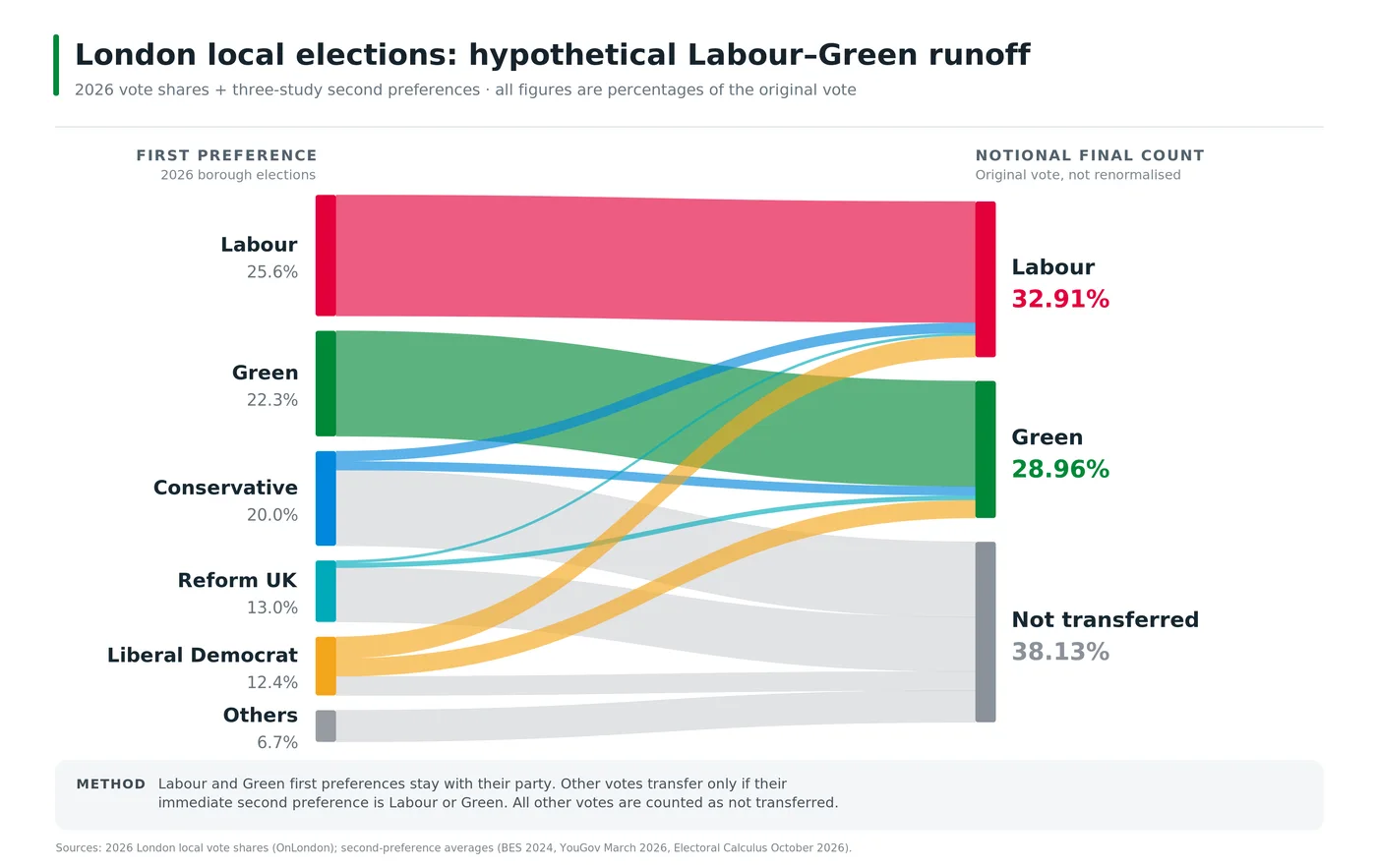
As you can see, this would have resulted in a loss to Labour of about 4 points. The polls before the local elections has Labour 3% ahead of the Green Party. What this shows us is that we would need to be at least 1% ahead of Labour in the national polls in order to have a shot of winning the London mayoralty.
This is actually a hefty task. But there may be a better path to winning the mayoralty.
In this scenario, the Green Party would run a very specific campaign with the aim of asking Labour voters to “lend” the Green Party their first preferences. This would be an explicit Green 1, Labour 2 campaign, which would have a lot of implications that I won’t detail here.
However, if 5.7% of the vote could be convinced to take this step (a solid 22% of Labour’s total supporter base) then that would put Labour in third, behind the conservatives. In this scenario, the preferences would distribute as follows.
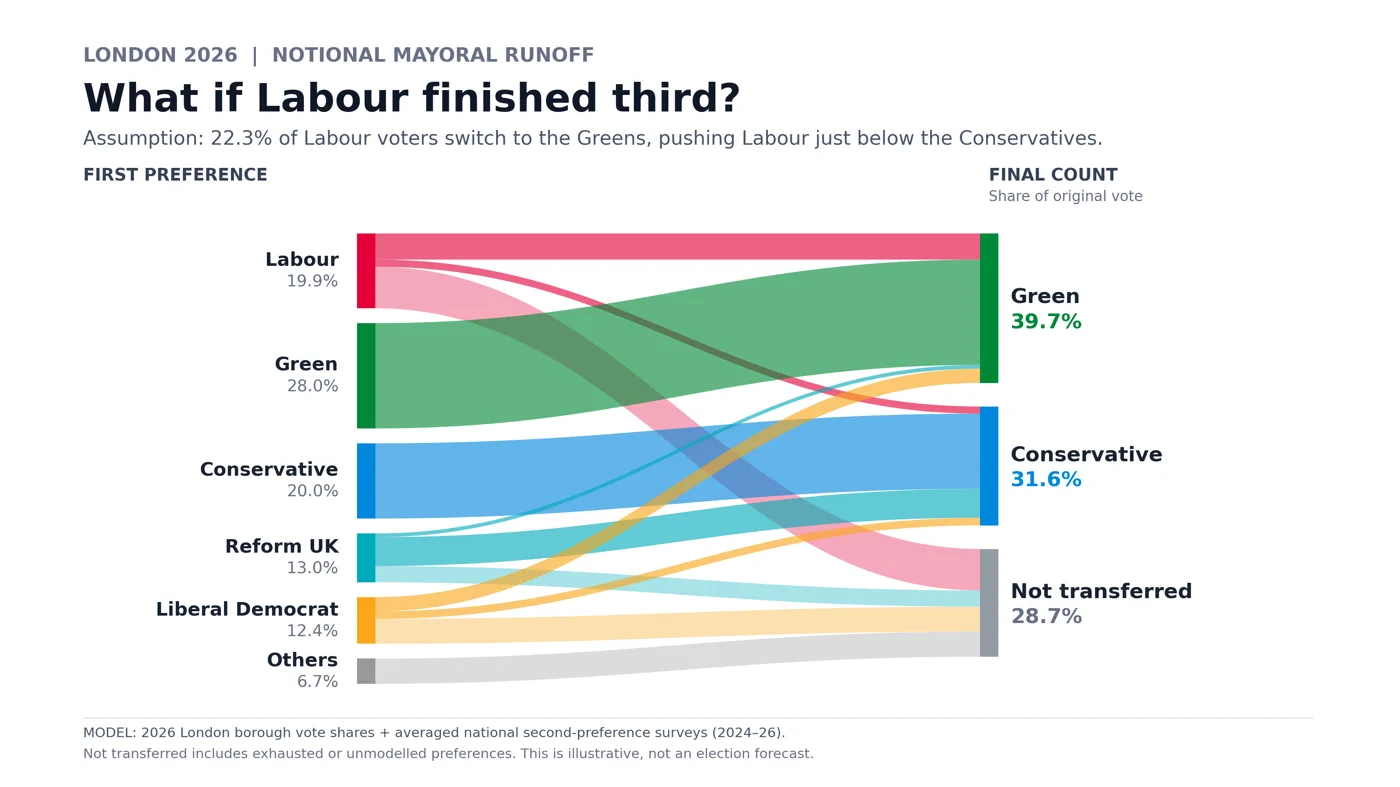
As you can see, based on the voter preference assumptions, this scenario would see the Green Party beating the Conservatives by 8.1 points.
Yet, this strategy does not require such a complete success in order to return a Green Mayor of London. Rather than needing 22% of the Labour vote to lend us their first preferences, the preference transfers actually result in a narrow Green victory if we convince as little as 8% of Labour supporters to do so.
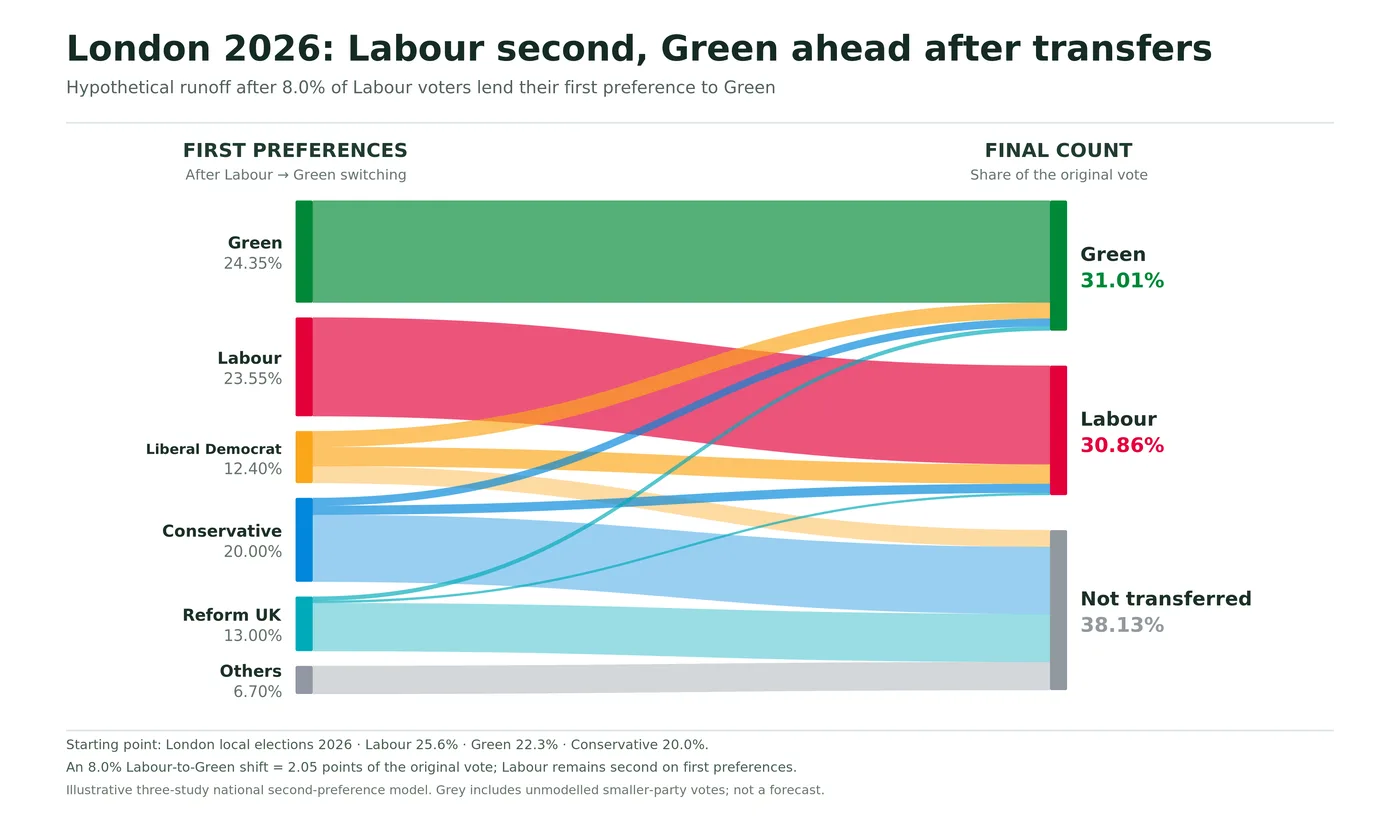
This model shows how the Green Party can win the London mayoralty without having to be ahead of Labour in the national polls, though we would still need to recover to the high point we achieved before the 2026 local elections.
My assessment is that this is perhaps the only realistic path to success in the London elections, and this is what brings us to political positioning. We have to ask ourselves, what would convince 8% of Labour’s London voters to lend us their first preference?
Obviously, a “stop Reform/Conservatives” message is counterproductive as it actively pushes support to Labour. Instead, we have to lean into what we have in common with Labour supporters, members, councillors and even MPs. Our positioning should be “You really can have what you want”.
This means articulating a detailed platform for London that deliberately touches on Labour dissatisfaction, which can be on a range of issues from housing to police reform, as well as common sense - but radical - policies on the environment. This contrasts with a constant attack on Labour and requires a genuine vision for London that entices Labour supporters to give us that shot.
There’s much more detail on what that vision should be, how we demonstrate our positions with credibility, how we leverage the Town Halls where we have control, and even what kind of candidate we need. Perhaps most important of all is how we restore our polling performance. But that’s all for another time.